DESIGN

Fire Suppression & Detection

Fire suppression and detection

Overview

Fire Suppression & Detection

We have extensive experience in the design, installation, and maintenance of fire suppression and detection systems. Our vendor neutrality ensures we are not committed to any individual manufacturer. Any fire suppression and detection system proposed for your data centre is specified based on its suitability for your facility.

GET STARTED

The Purpose of a Fire Suppression System Is To:

Gas Suppression Systems

Water Mist Systems

Oxygen Reduction Fire Prevention

Early Warning Smoke Detection Systems

WHAT TO KNOW

What to Consider when Building A Data Centre

How Fire Suppression Systems Protect Servers and Data

Room Integrity Test

Any suppression system agent that is discharged into an area of risk has to be able to remain there for a minimum 10 minutes, from the initial activation of the fire alarm or alert.
Secure I.T. Environments Ltd system installations are guaranteed to fulfill this requirement. As well as installations, our room integrity testing process is rigorous and as complete as any other within the industry.
Our professional engineers use the very latest in testing technology to provide thorough informative assessments concerning potential areas of leakage, advice and recommendations on further protection solutions, as well as full retention reports.


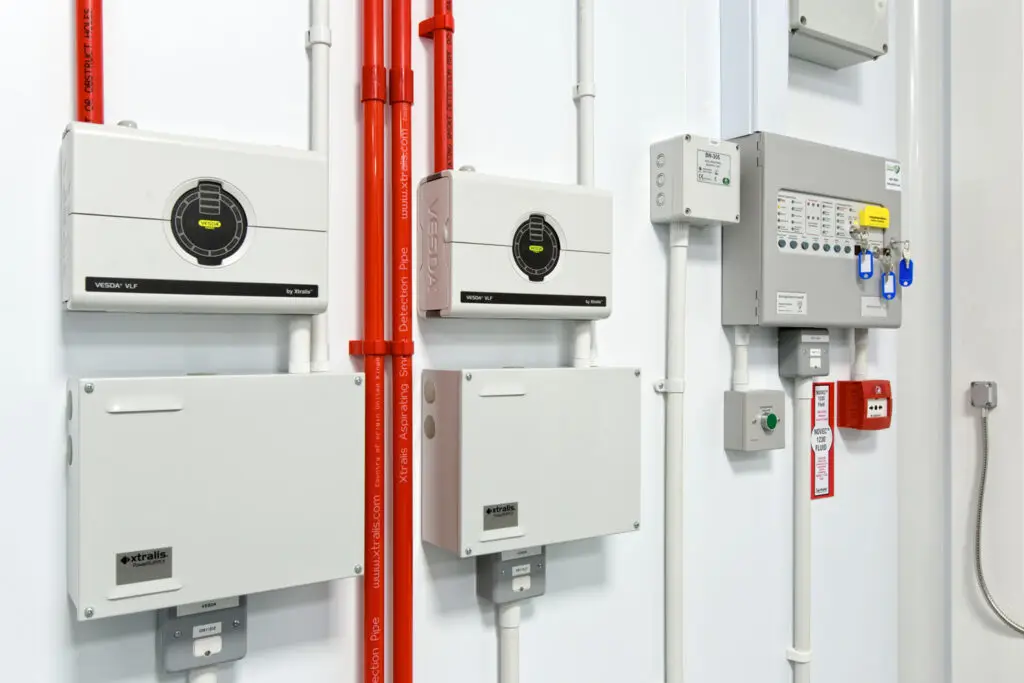
VESDA (Very Early Smoke Detection Apparatus)

VESDA is a laser-based smoke detector and has been used in specialist fire detection applications for over 20 years. VESDA is the most advanced aspirating smoke detection equipment in the fire industry. VESDA smoke detectors hold more certifications than any other aspirating smoke detectors in the world and are widely used for all installations by Secure I.T. Environments Ltd.

Room Sealing Service

We provide a complete turnkey fire suppression system solution. We will undertake all electrical room sealing and builders work as part of any fire suppression system deployment to ensure that the system will pass the room integrity test.

LEARN MORE

How to build a Data Centre for your business?

Whether traditional, containerised or modular our energy-efficient scalable approach to any challenge is developed to align with the overall strategy of each business client, ensuring we optimise every data centre design and future fit-out at every stage.

With an in-house data centre design and build team of engineers, we fully support our customer-preferred architecture solution, working closely with you to ensure your data centres are running seamlessly and meeting your requirements. Utilising the latest efficient data centre cooling systems and infrastructure industry standards, we ensure no disruption to mission-critical services or business continuity operations, giving you peace of mind when working with Secure IT Environments.

Get in touch with the team today!

Taking Care of
Everything You Need

Design And Build

From initial concept through to handover, we deliver turnkey data centre solutions tailored to your needs.

Maintenance

Our expert teams provide ongoing maintenance to ensure your data centre remains secure, efficient, and fully operational.

Modular Data Centres

Fast, flexible, and scalable — modular builds help you adapt to changing business demands with minimal disruption.

Containerised Solutions

Self-contained, portable data centres built for rapid deployment and optimal performance in any environment.

Upgrades and Refurbishments

We help modernise existing infrastructure, improving performance, security, and energy efficiency.

Secure Environments for Critical Infrastructure

Specialist design and implementation for high-security, mission-critical environments across government and commercial sectors.

FAQ

Answers to the Most
Common Questions

A data centre design and build service provides end-to-end solutions for creating a data centre. This includes planning, designing the infrastructure, and actual construction, ensuring an efficient and functional facility.
There are three key areas to consider when planning to build a new data centre to ensure the project meets the needs of the organisation it’s designed to serve: existing facilities, the organisation’s business needs, and the data centre technology environment. Having answers to specific questions in these three areas will put your organisation in a position to make the best choice for design, build, installation, and start-up of your new data centre.
Key to understanding how to plan and build a new data centre is knowing the details of your existing data centre setup and capacity, whether that is your own facility, a colocation provider, or a cloud service.
Getting a clear picture of what already exists helps determine if building a new data centre is indeed the right option. In this digital age It’s possible that colocation, outsourcing, or a cloud or hybrid model could best meet your organisation’s data centre needs.
As part of this evaluation process, it’s also critical to understand the goals of the business, and how the data centre meets the needs of the company. A key part of this is understanding the scale of IT in the organisation, as well as how the data centre and its operations align with the business. That requires looking closely at how much data the business deals with, how it is gathered, stored, and accessed, what contact uses the data and how, and the relevant industry standards the data centre must comply with.
After getting a good sense of organisational goals and how the existing facilities are serving the business, and could you scale this down. it’s also critical to understand the company’s technology and data center physical environments.
Data centre projects are complex undertakings. When it’s done right, a brand new data center will support your business objectives and meet current and anticipated future needs. The way to set up your organisation for success with this project is to understand existing data centre facilities, know the business needs of the organisation, and have knowledge of the necessary data centre and technology environment.
Buildings used as storage facilities are most often located in the suburbs, areas with uninterrupted power supply. The centres are built in a fenced area that is protected from unauthorised intrusion. Data centres are located in one- or two-storey buildings, in buildings using modular construction techniques or containerised units. They can also be built internal or external of a main building
The data center houses switching routing and storage hardware. The function of that hardware depends on the type of data center. There is also generally a large amount of power and cooling equipment as well as admin space. Some data centers are for access from a customer to a business’s serve
Sometimes they can be found in the city centres, refurbishing industrial buildings, storage facilities, and hangars. Buildings must meet strict requirements, must be selected based on the load-bearing capacity of walls and floors, and the materials used for construction.
To ensure an uninterrupted power supply, two mains from different substations, battery packs and emergency diesel generators are normally used. Switching to the emergency power supply is performed in milliseconds, so the risk of losing company data is minimised.
The timeframe can vary based on the size, complexity, and specific requirements of the project. Generally, smaller data centres might take a few months, while larger or more complex projects can extend to over a year.
Several factors are considered, including the client’s capacity needs, scalability, redundancy, cooling and ventilation systems, energy efficiency, and security measures. The geographical location and potential natural disaster risks are also evaluated.
We adopt the latest technologies and best practices, such as using energy-efficient hardware, advanced cooling systems, and renewable energy sources when possible. Regular energy audits also help in maintaining efficiency.
Absolutely. Our designs often incorporate modular elements that allow for easy expansion, ensuring the facility can evolve with growing data needs.

Costs can vary widely based on the size, location, technologies used, and other factors. We recommend reaching out with specific project details for a tailored estimate.

Data Centres

Case Studies

What are the requirements to build a data centre?

Glangwili Hospital – Carmarthen Wales

Queen Elizabeth Hospital Kings Lynn

Essex Partnership University NHS Foundation Trust

Testimonials

What Our Clients Say

Have any questions?
Feel free to contact us

Our Blog

Latest Articles

What Are Vertical Design Accelerators and Why They Matter in Modern Data Centre Projects

Designing a data centre often feels like standing at the base of...

Edge Data Centres and Low Latency Infrastructure – What does it mean?

The rise of edge data centres is quietly reshaping how digital services...

Supporting the NHS with Reliable and Energy-Efficient Data Centres

In the healthcare industry, the need for reliable and efficient data centre...